

Difference Between Stock Trading And Forex Trading
Traders often compare forex vs stocks to determine which market is amend to trade. Despite being interconnected, the forex and stock market are vastly unlike. The forex marketplace has unique characteristics that set up information technology apart from other markets, and in the eyes of many, also make it far more attractive to trade.
When choosing to merchandise forex or stocks, information technology often comes downward to knowing which trading style suits you best.Merely knowing the differences and similarities between the stock and forex market place also enables traders to make informed trading decisions based on factors such as market conditions, liquidity and volume.
Superlative 5 Differences between forex and stocks
The table below summarizes a few key differences between the forex market place and the stock market place:
| Forex Market | Stock Market place |
|---|---|
| Big volume- Around $v Trillion per day | Less volume – Roughly $200 billion per 24-hour interval |
| Highly Liquid | Less liquid |
| 24 Hour Markets | eight Hour Markets |
| Minimal or no commissions | Commissions |
| Narrow Focus | Wide Focus |
Let's take a more in-depth look into how exactly the forex market compares with equities (stocks).
1) Book
One of the biggest differences between forex and stocks is the sheer size of the forex market place. Forex is estimated to trade around $5 trillion a day, with most trading concentrated on a few major pairs like the EUR/USD, USD/JPY, GBP/USD and AUD/USD. The forex market book dwarfs the dollar volume of all the earth'southward stock markets combined, which boilerplate roughly $200 billion per mean solar day.
Having such a big trading volume can bring many advantages to traders. High book means traders can typically go their orders executed more easily and closer to the prices they want. While all markets are prone to gaps, having more liquidity at each pricing betoken meliorate equips traders to enter and exit the marketplace.
2) Liquidity
A market that trades in high volume generally has high liquidity. Liquidity leads to tighter spreads and lower transaction costs. Forex major pairs typically have extremely low spreads and transactions costs when compared to stocks and this is one of the major advantages of trading the forex market versus trading the stock market. Read more on the differences in liquidity between the forex and stock marketplace.
3) 24 Hour Markets
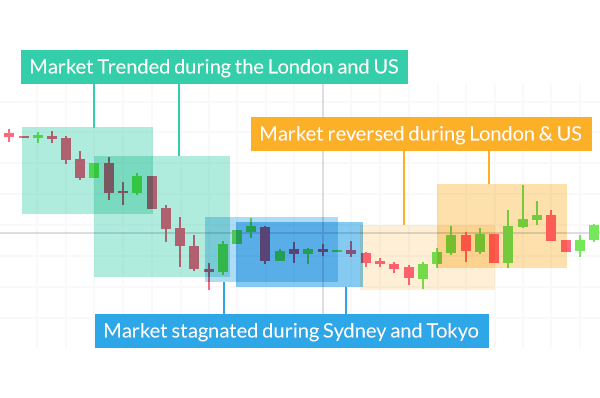
Forex is an over the counter market meaning that it is not transacted over a traditional exchange. Trading is facilitated through the interbank market place. This means that trading can go on all around the globe during dissimilar countries business organisation hours and trading sessions. Therefore, the forex trader has admission to trading virtually 24 hours a day, v days a week. Major stock indices on the other hand, merchandise at different times and are affected by different variables. Visit the Major Indices folio to discover out more nearly trading these markets-including data on trading hours.
4) Minimal or no commission
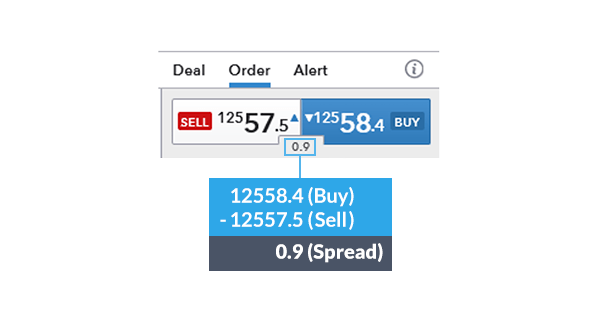
Most forex brokers accuse no commission, instead they make their margin on the spread – which is the difference betwixt the buy price and the sell price. When trading equities (stocks) or a futures contract, or a major index like the S&P 500, oft traders must pay the spread along with a commission to a broker.
Forex spreads are quite transparent compared to costs of trading other contracts. Below yous volition see the spread of the EUR/USD highlighted inside of the executable dealing rates. The spread can be used to calculate the toll for your position size upfront prior to execution.
5) Narrow focus vs broad focus
There are eight major currencies traders can focus on, while in the stock universe there are thousands. With only eight economies to focus on and since forex is traded in pairs, traders will look for diverging and converging trends between the currencies to friction match upwards a forex pair to trade. Viii currencies are easier to keep an heart on than thousands of stocks.
The variables that consequence the major currencies can be easily monitored using an economic calendar.
Should you lot trade forex or stocks?
Whether you lot choose to trade forex or stocks depends profoundly on your goals and preferred trading style.
The table below shows dissimilar types of trading styles, including the pros and cons of each when trading forex and stocks.
| Type of Trader | Definition | Advantages | Disadvantages | Forex vs Stocks |
|---|---|---|---|---|
| Short- Term (Scalping) | A trading style where the trader looks to open up and close trades within minutes, taking advantage of small-scale cost movements. | Traders can focus more on volatility and less on central variables that move the market. | As a event of placing more than trades, beginner traders may lose more money if their strategy isn't fine-tuned. | Suited to forex trading due to inexpensive costs of executing positions. Some exchanges require large capital account balances to trade. Virtually forex brokers only require y'all to have enough capital to sustain the margin requirements. |
| Medium-Term | A trading manner where the trader looks to hold positions for one or more days, where the trades are oftentimes initiated due to technical reasons. | Lower capital requirements compared with other styles because a trader is looking for larger moves. | Trades must be accompanies with analysis which may take time. | Suited to trading forex and stocks. |
| Long-Term | A trading way where a trader looks to hold positions for months or years, frequently basing decisions on long-term fundamental factors. | Traders exercise not have to spend as much time analysing. | Big capital requirements required to cover volatile movements. | Suited more than to stock trading because the forex market tends to vary in direction more than stocks. |
If you are new to trading forex download our complimentary forex for beginner s guide . Nosotros also provide free equities forecasts to back up stock market trading.
Forex vs other markets FAQs
How can I transition from forex trading to stock trading?
To move from forex to stock trading y'all volition need to empathize the fundamental differences between forex and stocks. When yous boil it down, forex movements are acquired past interest rates and their anticipated movements. Stocks are dependent on acquirement, balance sheet projections and the economies they operate in amongst other things. Discover out more on how to transition from forex to stock trading.
Are there any differences between forex and commodities trading?
Forex and bolt differ in terms of regulation, leverage, and commutation limits. Forex markets are a lot less regulated than bolt markets whilst bolt markets are highly regulated. In terms of leverage, it exists in both the forex and commodities market, but in the forex market it is more than pop due to greater liquidity and lower volatility (leverage can amplify losses and gains).
Also, similar stocks, commodities trade on exchanges. Commodity exchanges set roofs and floors for the toll fluctuations of commodities and when these limits are hit trading may exist halted for a certain time depending on the production traded. The forex and stock market do not take limits that tin prevent trading from happening.
Continue upwardly to date with electric current currency, commodity and indices pricing on our top rates page . Besides, see our skillful trading forecasts on equities, major currencies the USD and EUR, or read our guide on the Traits of Successful traders for insight into the top mistake traders make.
DailyFX provides forex news and technical assay on the trends that influence the global currency markets.

Difference Between Stock Trading And Forex Trading,
Source: https://www.dailyfx.com/education/beginner/forex-vs-stocks.html
Posted by: wilsonothem1991.blogspot.com
0 Response to "Difference Between Stock Trading And Forex Trading"
Post a Comment